Why St David's?
St David's is extraordinary for a very simple reason: it punches far above its weight. Britain's smallest city — technically a city by virtue of its ancient cathedral — has barely 2,000 residents, no traffic lights, and a single main street. What it does have is one of the most spectacular stretches of coastline in the British Isles sitting right on its doorstep.
The headland west of St David's is as wild and remote a piece of coast as you'll find in Wales. The rocks here are among the oldest in Pembrokeshire — ancient Precambrian volcanic formations shaped by forces that have nothing to do with the gentle limestone coves further south. The result is a coastline of cathedral-scale sea caves, cathedral-blue water, and a quality of light on a clear evening that genuinely has to be seen to be understood. This is where John Byrom has been running adventures for over a decade.
John Byrom & Be Adventurous
John Byrom isn't just a guide — he's one of the most qualified and experienced coasteering instructors in the UK. An NCC Trainer of Guides (the highest coaching level in the sport), he is the person who trains other people's guides. He knows this coastline with the depth of someone who has paddled, swum and climbed every channel, cave and jump line across the seasons, in all conditions, over many years.
His operation, Be Adventurous, runs under the Coastal Play brand, and offers coasteering, sea kayaking and stand-up paddleboarding from the St David's peninsula. The groups are small, the briefings are thorough, and the approach combines genuine technical expertise with the kind of relaxed enthusiasm that comes from someone who is clearly doing exactly what they were made to do.
"This coastline is unlike anything else in Pembrokeshire. The geology, the water clarity, the sense of scale — there's nowhere quite like it."
 John Byrom leading a coasteering session on the volcanic coastline west of St David's.
Day One Morning: Coasteering the Volcanic Coast
Start your weekend with coasteering — the activity that defines this stretch of coast more than any other. Be Adventurous operates on the ancient volcanic formations near the Blue Lagoon, a sheltered inlet of crystalline water enclosed by dark, angular rock that looks more like Iceland than West Wales. The contrast with the red sandstone coasteering routes further south couldn't be more stark.
The Blue Lagoon itself is a natural swimming hole of unusual clarity — the volcanic rock doesn't leach the tannins that colour water brown in other parts of Pembrokeshire. On a bright morning, the water shifts from turquoise at the surface to deep jade below, and the sea caves here penetrate deep into the headland, opening into chambers where the only light comes from behind you. John knows every one of them.
Expect a morning of swimming channels, moderate jumps — nothing is compulsory — cave exploration, and the kind of whole-body engagement with a wild environment that is very difficult to find anywhere else. You'll be back at your vehicle by lunchtime, already wondering when you can do it again.
All kit — wetsuit, helmet, buoyancy aid — is provided. No experience is needed; John's briefings cover everything. Sessions run April to October, weather and sea conditions permitting. Minimum age varies by session — check when booking. Wear swimwear underneath and bring a towel and warm layers for afterwards.
BOOK COASTEERING WITH JOHN
Check availability for Be Adventurous coasteering sessions on the St David's peninsula.
Book Coasteering →Day One Afternoon: Kayaking the St David's Peninsula
After lunch — and a proper coffee at one of St David's good cafés — the afternoon opens up a different perspective on the same coastline. Sea kayaking with Be Adventurous takes you out along the peninsula from a sheltered launch point, pushing west towards some of the most dramatic sea stack and sea arch formations on the Pembrokeshire coast. Paddling here is a more contemplative experience than the morning's coasteering — quieter, more spacious, with the full scale of the headland revealing itself as you move along the cliffs.
The paddling here is genuinely varied. Sheltered coves alternate with exposed headlands where Atlantic swell rolls in unimpeded, and the bird life in summer — razorbills, choughs, the occasional peregrine — makes the whole thing feel like a slow-motion nature documentary. John reads the sea conditions carefully: routes flex depending on wind and swell, always prioritising the best experience the day allows.
 Paddling the St David's peninsula — inaccessible coastline from a completely different angle.
Saturday Evening: Sunset at St Justinian's
After two sessions on the water, your legs might be happy to walk rather than paddle. St Justinian's — a small, ancient lifeboat station and tidal harbour just two miles west of St David's — is the perfect evening destination. It takes fifteen minutes to drive, less to walk if you're staying nearby, and the reward is some of the finest coastal scenery in Pembrokeshire viewed at its most dramatic hour.
The position is superb: St Justinian's sits directly opposite Ramsey Island, separated from the mainland by Ramsey Sound — a fast-moving tidal channel that churns dramatically at full flow. The island itself rises to around 130 metres, providing a natural canvas for the light as the sun drops toward the Atlantic horizon. On a clear evening the sky above Ramsey can run through the full spectrum from pale gold to deep amber and eventually to the deep blue that lingers long after the sun has gone. Ravens and choughs work the updrafts above the cliff edge; grey seals haul out on the rocks below.
There's a small car park and the historic lifeboat station — still operational — at the end of the lane. Walk north along the coast path for 10 minutes for more expansive views across Ramsey Sound, or simply find a comfortable rock and watch the light change. Either way, you'll be back in St David's in time for dinner.
Where to Eat: Saturday Night in St David's
For a city of fewer than 2,000 people, St David's punches well above its weight for food. The concentration of good restaurants in the centre is a pleasant surprise after a day in the wild.
For a Special Occasion
Blas Restaurant at the Twr y Felin Hotel is the headline act — set inside a converted windmill and widely regarded as one of the finest restaurants in West Wales. The menu celebrates Pembrokeshire produce with serious technique: local seafood, Welsh beef, foraged ingredients. Book ahead, especially in summer. It's the kind of place you earn after a full day of outdoor activity.
For Something More Relaxed
The Really Wild Emporium on the High Street is a multi-award-winning café and restaurant that has become something of an institution. The approach is seasonal and creative — expect dishes built around whatever is local and interesting that week, with a strong commitment to Welsh ingredients and a genuinely warm atmosphere. Great for post-adventure hunger without the formality of a fine dining booking.
Classic Pub Dinner
The Farmers Arms in the city centre is the reliable choice — a traditional Welsh pub with proper pub food done well, including fresh Pembrokeshire fish, hearty pies, and a good selection of real ales. The kind of place that feels exactly right when you've spent the day outdoors and all you want is somewhere warm, unpretentious, and satisfying. Dog-friendly too.
St David's is small and popular. In peak season (July–August) and on summer weekends, the better restaurants fill up quickly — booking a table for the same evening can be difficult. Reserve your Saturday night dinner before you arrive, or at least before you go coasteering.
Day Two Morning: SUP on Calm Water
Sunday morning calls for something gentler. Stand-up paddleboarding with Be Adventurous is the ideal counterpoint to the physical intensity of Saturday's coasteering — quieter, more meditative, and perfectly suited to the kind of glassy morning conditions that the St David's peninsula often produces in settled weather.
John's SUP sessions launch from sheltered locations chosen to make the most of the conditions on the day. The pace is relaxed, the instruction clear and unrushed, and the rewards — standing upright on flat water with the Pembrokeshire sky above and a coastline to explore — are immediately obvious. It's also the activity that catches most people off guard: they arrive thinking it will be the easy option after coasteering, and leave having discovered that maintaining balance and paddling efficiently is its own engaging challenge.
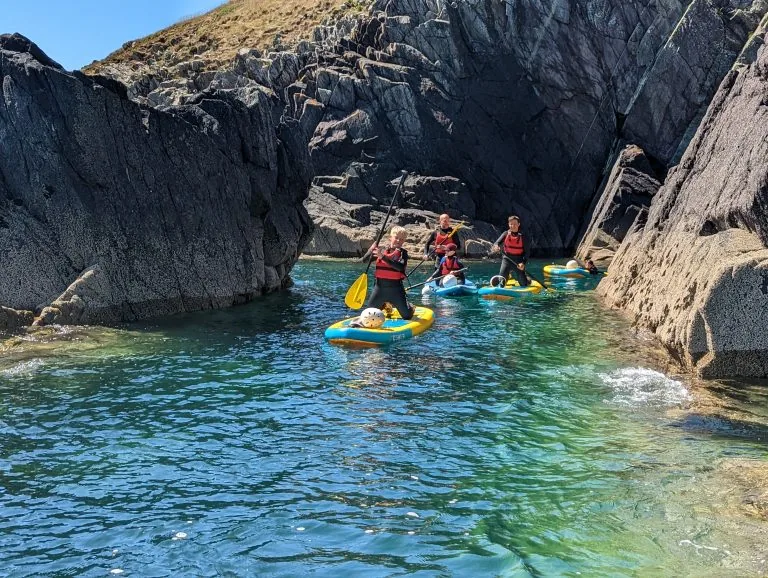 Sunday morning SUP — the St David's peninsula in calm conditions.
BOOK SUP WITH BE ADVENTUROUS
Stand-up paddleboarding sessions on the St David's peninsula — all kit included, all abilities welcome.
Book SUP →Sunday Evening: Carn Llidi at Dusk
Before you head for home, there is one more thing worth doing. Carn Llidi is the rocky hill that dominates the skyline north of Whitesands Bay — an ancient volcanic peak that rises to 181 metres above the beach and provides what is probably the finest panoramic viewpoint in Pembrokeshire. On a clear evening, the summit view takes in the full length of the Pembrokeshire Coast National Park, Ramsey Island to the south-west, the Preseli Hills inland, and — on the best days — the Wicklow Hills across the Irish Sea.
The approach is straightforward: park at Whitesands Bay and follow the coastal path north and west towards St David's Head, then pick up the path that climbs directly to the rocky summit. It's a 45-minute walk to the top, with some easy scrambling near the peak. Take it at an unhurried pace in the evening light, with the St David's peninsula laid out below you and the Atlantic glittering to the west, and you'll have the best possible send-off for a weekend that has used all of its landscape very well.
Carn Llidi is also — it's worth saying — a profoundly ancient place. The summit area contains the remains of a Neolithic burial chamber and Iron Age field systems. People have been making their way up here for at least six thousand years, drawn by the same instinct: to see the whole of it at once, and to feel the scale of this piece of coast from above.
"From the top of Carn Llidi on a clear evening you can see further than you can from anywhere else in Pembrokeshire. It's one of those places that puts everything into perspective."
Park at Whitesands Bay car park (LL65 1YH — use a postcode near Whitesands). The walk to the summit and back is approximately 4–5km and takes 1.5–2 hours at a relaxed pace. Wear proper footwear — the upper section is on loose volcanic rock. Check sunset times and allow enough time to descend in daylight. The path is not lit.
Practical Information
St David's is approximately 2.5 hours from Cardiff, 3.5 hours from Bristol and around 5 hours from London. The most practical approach is by car — a vehicle gives you flexibility to reach activity launch points and the evening walk destinations easily. There is no direct public transport to St David's from the major rail hubs, though National Express coaches serve Haverfordwest (10 miles east), from where a taxi or local bus can complete the journey.
Accommodation in St David's ranges from camping and glamping at several nearby sites to B&Bs and boutique hotels in the city itself. The Twr y Felin Hotel (home of Blas Restaurant) is the most distinctive option in the city; for something simpler, several well-regarded B&Bs operate within walking distance of the centre. Book accommodation well in advance for summer weekends and bank holidays — St David's fills up quickly.
Be Adventurous activities run April through October. John Byrom's sessions are popular and tend to fill up at peak times. Booking a week or more ahead is strongly recommended for summer weekends. Check the activity pages for current availability and to secure your spot.