Before It Had a Name
People had been traversing the Pembrokeshire coastline at sea level for as long as there were people in Pembrokeshire. Fishermen, wreckers, smugglers — all moved along these cliffs for practical reasons, swimming channels and scrambling ledges with no thought of sport or recreation. What changed in the 1980s was the idea that doing so deliberately, for the pure experience of it, was worth formalising.
The word "coasteering" is generally credited to Andy Middleton of TYF Adventure (Twr Y Felin), who began guiding clients around the sea cliffs of St David's Head in the mid-1980s. Based out of St David's — the smallest city in Britain — TYF was among the first companies anywhere to commercialise guided outdoor adventure. They deserve the credit for naming and formalising the sport.
But the spirit of coasteering predates the name. Long before guided sessions existed, Pembrokeshire surfers had been using flat days to explore the coastline from the water. When the swell dropped, they'd scramble out along the cliffs, hunting for jumps they hadn't tried, pushing into caves only accessible at low tide, finding lines through the rock that no one else knew about. It was exploration for its own sake — informal, unguided, and entirely motivated by the same curiosity that drives the sport today. The commercial version formalised what local adventurers had been doing for years.
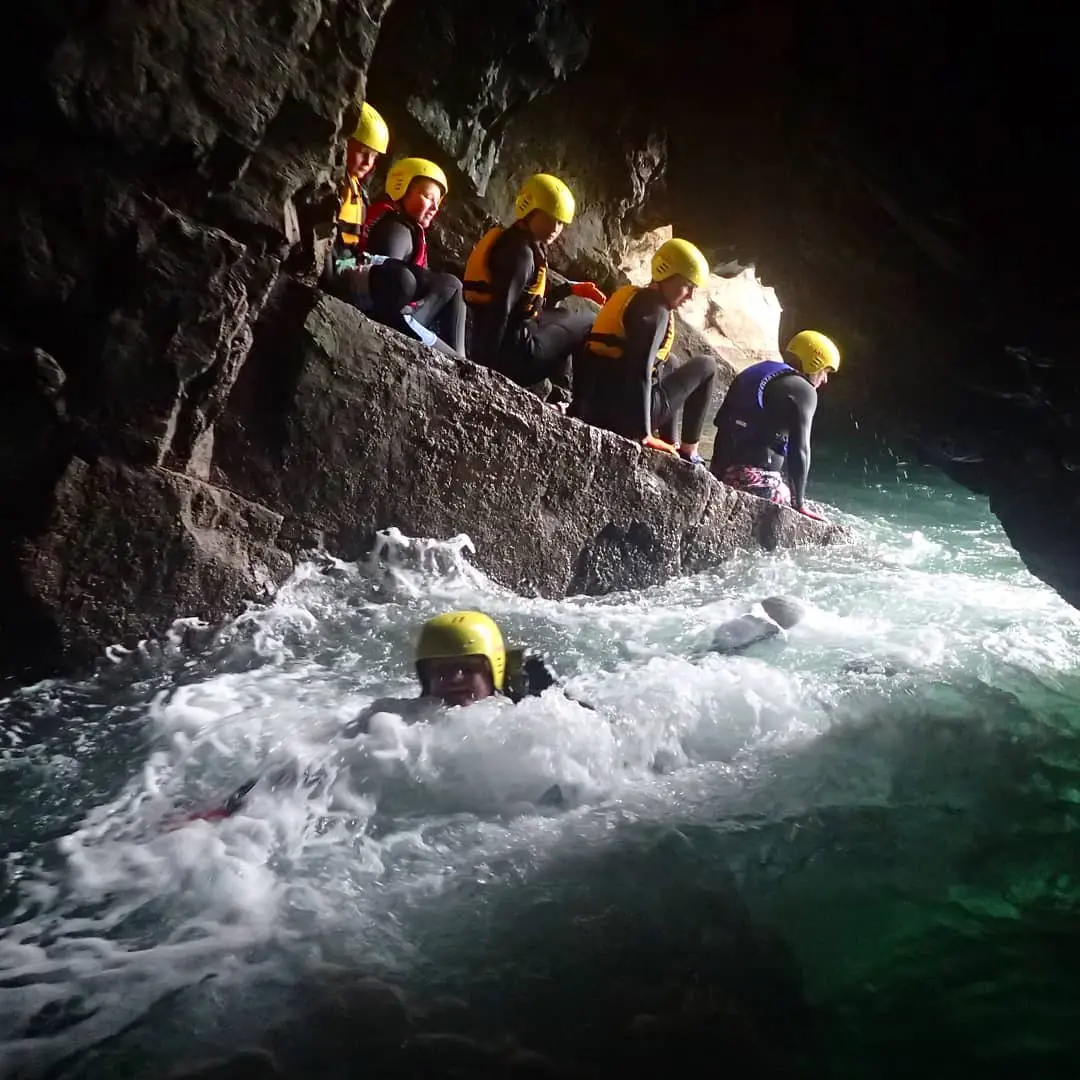 The sea caves of south Pembrokeshire — accessible only at the right state of the tide, and the reason coasteering exists.
"The water was cold, the rock was sharp, and absolutely everything felt alive. There was nothing else like it. There still isn't."
The Qualification Framework
For years, coasteering existed as an entirely unregulated activity. Guides operated on judgment, experience and local knowledge — a model that worked well when the industry was small and the operators were genuinely expert, but posed obvious risks as demand grew through the 1990s and early 2000s.
The answer was the National Coasteering Charter (NCC) — an industry-led framework that set the standards for how coasteering should be guided, assessed and delivered safely. The NCC developed the Guide Award: a structured qualification covering coastal navigation, tidal awareness, sea safety, rescue techniques and client leadership. Among the key figures in building the NCC Guide Award was John Byrom of Be Adventurous, a North Pembrokeshire operator whose deep knowledge of the coastline and commitment to rigorous assessment helped shape the qualification as it exists today. The NCC remains the benchmark for professional coasteering operators across the UK.
The National Coasteering Charter (NCC) sets the standards for professional coasteering in the UK. The NCC Guide Award assesses competency in coastal navigation, rescue techniques, risk assessment, tidal awareness and client management. Pembrokeshire Adventure providers follow NCC recommendations and operate to the standards the Charter defines.
From Welsh Niche to Global Sport
Through the 2000s, coasteering spread from its Pembrokeshire roots to the rest of Britain, then to Ireland, then to New Zealand, Australia and eventually every coastline in the world where people wanted a more immersive way to experience the sea. The word entered the Oxford English Dictionary. Red Bull Cliff Diving — which uses the Blue Lagoon at Abereiddy as one of its regular World Series stops — brought televised cliff-jumping to a global audience, and interest in the sport surged.
What's remarkable is how little the experience itself has changed since those first guided sessions in the 1980s. The equipment is better — modern wetsuits, helmets, and buoyancy aids are considerably more comfortable than what early guides were working with. The qualification framework means standards are higher. But the fundamental draw — raw exposure to an extraordinary landscape, entering the sea where it meets the rock, the shock of cold water and the clean adrenaline of a good jump — is exactly what it was when Andy Middleton first started taking clients around St David's Head.
 The Blue Lagoon at Abereiddy — now an international venue for cliff diving and the most recognisable image in coasteering.
EXPERIENCE IT YOURSELF
Book a coasteering session with the direct descendants of Pembrokeshire's founding operators.
Book Coasteering →Pembrokeshire Today
Pembrokeshire remains the global centre of gravity for coasteering. The combination of world-class locations — the Blue Lagoon, St Non's Bay, the Lydstep limestone cliffs, the cave systems of south Pembrokeshire — with a community of genuinely expert guides who have been developing these routes for decades, makes it the destination of choice for anyone who wants to understand what the sport is really about.
The operators on this platform represent that direct lineage. Between them, the guides at Tenby Adventure and Be Adventurous have decades of experience on this coastline, hold the highest industry qualifications, and were themselves trained by some of the people who built the sport. When you book a coasteering session here, you are tapping into something that goes back to the beginning.
 John Byrom of Be Adventurous — NCC Trainer of Guides, and part of the direct lineage that connects modern coasteering to its Pembrokeshire origins.